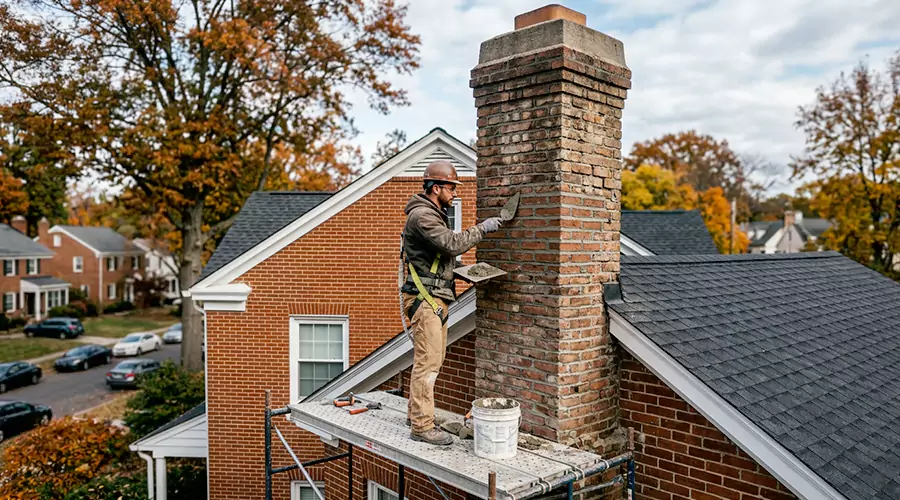
What Is Chimney Repointing
Chimney repointing costs $500 to $2,500 in 2026. Learn the signs of deteriorating mortar, the repointing process, and when repair is not enough.




Based on 500+ Reviews

Proudly American
Owned & Operated

Chimney repointing is the process of removing deteriorated mortar from the joints between chimney bricks and replacing it with fresh mortar. The repair restores weakened joints, reduces water penetration, and helps preserve the chimney without replacing otherwise sound bricks.
Mortar is designed to weather before masonry units do. Because a chimney sits above the roof and is exposed to rain, wind, freezing temperatures, and sunlight, its mortar joints can deteriorate faster than many other parts of a home.
A chimney needs repointing when the mortar between the bricks begins to crack, crumble, or wash away. Once joints open, water can enter the masonry. Continued moisture exposure may eventually contribute to loose bricks, spalling, interior leaks, or larger structural repairs.
Common causes of deteriorating mortar include:
The condition should be addressed while most of the bricks remain structurally sound. Repointing is intended to preserve existing masonry rather than rebuild the entire chimney.
Deteriorated mortar is often visible from the ground before the chimney develops major structural problems. The joints may look recessed or uneven compared with surrounding areas.
Watch for these warning signs:
Crumbling or recessed mortar is one of the clearest signs that repointing may be necessary. Open joints allow moisture deeper into the chimney and can accelerate deterioration.
The basic repointing process involves removing failed mortar without damaging the surrounding brick. The joints are cleaned before compatible new mortar is packed into the openings. The new material is then tooled and allowed to cure.
A typical project follows these steps:
| Step | What Happens |
|---|---|
| Inspection | Damaged mortar and bricks are identified |
| Mortar removal | Loose material is carefully removed |
| Joint cleaning | Dust and debris are cleared |
| Preparation | Masonry is prepared for new mortar |
| Repointing | Fresh mortar is packed into the joints |
| Tooling | Joint surfaces are shaped and finished |
| Curing | New mortar is protected while it hardens |
Removing enough deteriorated mortar is important because new material needs a solid surface to bond with. Care is also required to avoid chipping brick faces during removal.
The replacement mortar should be compatible with the existing masonry. Using mortar that is significantly harder than older bricks can contribute to cracking or spalling because movement and moisture may be forced through the brick instead of the joint. Older chimneys may require softer mortar with more lime. Newer masonry repair may use a different formulation.
The correct material depends on:
Choosing mortar based only on color can lead to problems. Physical compatibility is more important than creating a visually perfect match. Fine Homebuilding specifically cautions that repointing mortar should not be harder than the brick it surrounds.
Repointing and tuckpointing are related but technically different. Repointing replaces deteriorated mortar to restore the integrity of masonry joints. Traditional tuckpointing uses contrasting mortars to create the appearance of very fine, uniform joints. The terms are frequently used interchangeably in modern masonry repair pricing. HomeGuide separates them by noting that repointing restores mortar while tuckpointing adds an aesthetic element.
Both methods involve work on mortar joints, but structural repair is the primary goal of repointing.
Chimney repointing commonly costs about $500 to $2,500 in 2026. Pricing can range from roughly $8 to $30 per square foot depending on chimney height, mortar condition, roof slope, and accessibility. Complex two-story chimney stacks can cost considerably more.
| Project Condition | Typical Cost |
|---|---|
| Small localized repair | $500+ |
| Typical chimney repointing | $500 to $2,500 |
| Per-square-foot work | $8 to $30 |
| Difficult multi-story project | Up to $5,000 to $7,000 |
Labor makes up a large part of the total because removing old mortar and installing new material is detailed work. Scaffolding or other access equipment can also increase the price.
Repointing works best when the bricks remain stable and deterioration is concentrated in the mortar joints. It cannot restore bricks that have severely cracked, crumbled, or shifted.
A partial rebuild may be more appropriate when:
A roofline chimney rebuild generally costs about $1,000 to $3,500 in 2026, while complete chimney replacement can reach $4,000 to $15,000. This makes early mortar repair important because the goal is to preserve the existing chimney before rebuilding becomes necessary.
A basic visual inspection can be performed safely from the ground. Use binoculars or a camera with zoom to look at mortar lines from several angles. Look for joints that appear deeper than neighboring joints. Check areas close to the crown because upper sections receive significant weather exposure. Watch for brick fragments or mortar pieces on the roof.
Do not climb onto a steep roof simply to test mortar with your hands. Roof-level inspection should be left to someone with appropriate access and safety equipment.
Properly completed repointing can last for many years, but lifespan varies with weather exposure and material compatibility. A chimney that remains wet because of crown or flashing problems may experience deterioration much sooner. Repointing should therefore be combined with correction of any active water-entry problem.
Regular visual checks can help detect small areas of mortar loss before widespread work becomes necessary.
The best prevention strategy is controlling moisture and addressing small defects early.
Helpful maintenance steps include:
Water management is especially important because repeated saturation can accelerate both mortar and brick deterioration.
Chimney repointing removes deteriorated mortar and replaces it with compatible new material while preserving sound bricks. It is most effective when mortar joints are failing but the chimney remains structurally stable. Typical projects cost around $500 to $2,500 in 2026. Check visible mortar from the ground and investigate new cracks or missing joints before water damage spreads through the masonry.
Crumbling mortar, recessed joints, visible gaps, or loose mortar pieces are common warning signs.
Most chimney repointing projects cost about $500 to $2,500 in 2026. Difficult access can increase the total.
It can stop water entering through deteriorated mortar joints. It will not correct leaks caused by damaged flashing or a cracked crown.
Yes. Localized repointing may be possible when deterioration is limited to a small area and the remaining joints are sound.
It helps preserve structural integrity by restoring deteriorated mortar joints. Severe structural movement may require rebuilding instead.
Visible masonry should be checked periodically and after severe weather. New cracking or mortar loss should be investigated before it spreads.
Chimney repointing costs $500 to $2,500 in 2026. Learn the signs of deteriorating mortar, the repointing process, and when repair is not enough.
